
 Raising Kids
I don’t know why a trip to the grocery store with my oldest always results in a public temper tantrum, but it does.
For the longest time, he would exhibit something close to a mental breakdown over the kiddie shopping carts.
Whomever invented those is the bane of my existence.
My son is a strong-willed child, who struggles with transitions and wanting to be in-control of situations. No idea where he got that from!
{Raises hand}
Despite all my best efforts to stave them off, there is rarely a moment when we enter into public places that a tantrum or power struggle doesn’t try to make a grand appearance.
Today my complaining child was enraged because his sister got to sit in the front of the cart and he had to sit in the back of the cart. She’s a baby. He’s in preschool.
Sigh.
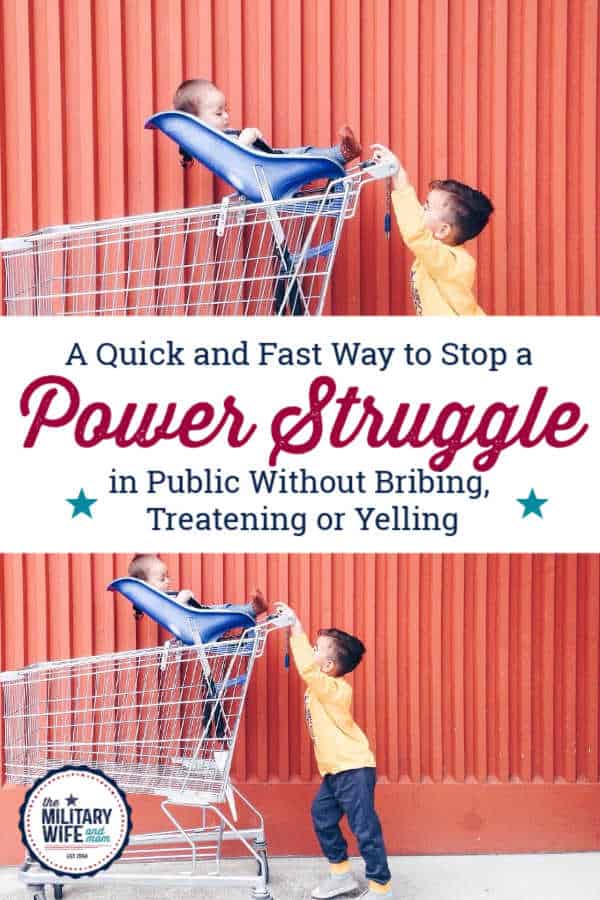
What can I say?
A baby in the back of a shopping cart isn’t a reasonable option. He continued with his hysterical crying and I continued with my shopping, hoping that we could get through this and head home in under 10 minutes.
As I placed my bananas in the shopping cart, he threatened to throw them out saying they were “the wrong bananas.” I contemplated leaving. We were never going to finish a shopping trip this way.
Unfortunately, there wasn’t any food in the house that constituted a legit meal, and eating out in public didn’t look like a bright idea either.
If I couldn’t muster a 10-minute grocery trip without one kid screaming, I doubt we’d survive 30 minutes in a restaurant without inserting the fear of God or going insane. Whichever came first.
This was about power.
Tantrums, power struggles or flat out not listening in public is almost always about power balance.
From a developmental standpoint, kids feel like you’re making them doing something like grocery shopping or going to the bank or sitting still at a restaurant, and they feel powerless.
It’s like mom and dad always get to tell them what to do, and they never have a say. All people have a need for power: moms, dads, kids, caregivers, and non-parents too.
So the question of the day is…
How do you meet your child’s need for power while still holding your parenting boundaries?
A quick and easy tip for stopping a power struggle in a pinch.
My son was still flailing around the back of the cart begging for me to put his baby sister back there. In my mom brain fog, a moment of clarity hit: This wasn’t about the back of the cart or the front of the cart or the “wrong bananas.”
This was about him wanting to control something in the situation.
I picked up two oranges, held them into the air, and said “Which do you choose?” He picked the orange he thought we should buy, and I put it into the cart.
Within minutes, he was calm and cooperative.
We moved along the produce section. I picked up two bunches of grapes, extended them out to him, and again asked, “Which do you choose?” He picked the left bunch, which was identical to the right bunch.
Related posts:
- 2 Year Old Not Listening? Try This Remarkable Tip
- One Quick Tip for When Your 3 Year Old Is Not Listening

And just like magical fairy dust sprinkled down from the sky, the balance of power was now even.
We did it again and again, aisle-by-aisle, item-by-item until our cart was full. Many of the items he was allowed to choose between were identical. He simply appreciated that the final items landing in the cart was his choice.
Somehow I managed to stop a power struggle at the grocery store.
Here’s why this parenting trick works.
This technique sounds too good to be true, but offering kids the ability to control small choices, reinstates the balance of power and creates peace.
This is very similar to one of my favorite Helpful Phrases, “You have two choices!”
You can play around with how you present two choices to kids: Offering two choices and then finishing with the question, “Which do you choose?” works equally as well as “You have to choices” and then offering the choices.
This simple little choice game can be applied to all sorts of different public situations, like getting kids to listen near streets and highways. It even works at home when doing a toddler bedtime routine.
All you need to do is find any small choice that your child can make to feel a sense of power and control over the situation.
It might sound something like this…
You can go through the left door or the right door. Which do you choose?
You can eat with this fork or that fork. Which do you choose?
You can put a small amount of ketchup on your plate or a large amount. Which do you choose?
Create a choice out of anything at all, even if it seems inconsequential or silly to you. To your child, these choices are a big deal. If you find that offering two similar choices isn’t working well, you can offer two different choices.
The most important thing is that you are offering a choice that fits within your parenting boundary, and you are framing it as something the child can do, rather than can’t do.
Here’s what happened when it was time to check out.
As I checked out at the grocery store, both kids were peaceful and calm and quiet. I felt a huge sense of accomplishment. Like I worked some parenting black magic on the kids.
But…
All good things must come to an end.
When we got to the car, I unloaded the bags into the trunk, put the kids in their car seats and left the cart in the parking lot.
My son was in tears—again. This time my spirited toddler wanted to “drive” the car, and we needed to leave. Parenting is messy and imperfect. There are tears and emotions and power struggles.
But at least—for 10 minutes—there was peace, harmony, happiness and even some magical fairy dust between the kids and me.
It was the best 10 minutes of our day, and I’m okay with that.














The part of the story where the child wanted to drive. I would say, “Absolutely! When you turn 16, the law says you can start learning how to drive. I think kids like explanations and not just no you can’t. They want to know why they can’t drive or do whatever the parent says no to.