
 Raising Kids
Inside: Learn the most important (and overlooked) reason why kids won’t listen, focus or sit still. Plus, get 25+ ways to help your kids build these important life skills.
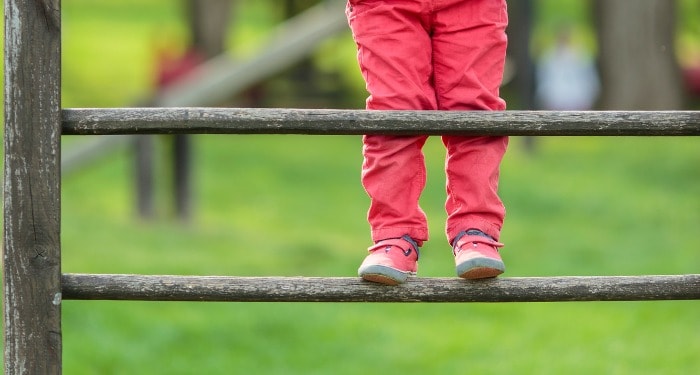
My son climbed to the top of the monkey bars and snaked across them from above. He’s not strong enough to swing across arm-to-arm, so his solution is to catapult his legs up, pull his entire body on top of the bars, and slither across.
A mom walked up to me. “Your son’s on top of the monkey bars. Just thought I’d let you know so he doesn’t fall and get hurt.”
Shortly after, two kids walked up and said, “He’s on top of the monkey bars! He’s going to get hurt.”
Related: 2 Year Old Not Listening? Try This Remarkable Tip
It happened in other situations, too.
When I took my two kids to a Merry-Go-Round, and let them have it as I sat on a picnic bench watching from afar, parents and kids alike voiced their concerns.
“Someone is going to break their arm over there!”
“She’s going to fall and get hurt.”
“He’s spinning, and he’s going to get sick.”
Same thing when people saw my kids hanging upside down (per their own doing) for several minutes at a time.
“All the blood is rushing to his head. It’s gonna make him sick.”
“That’s too dangerous!”
Or when people saw my kids twisting and spinning around on a swing.
“Someone is going to get their fingers pinched!”
“That’s not safe. Put your bottom on the swing.”
The bigger issue occurred — for other parents — when my kids did these things and their children wanted to join in the “dangerous” activity. This is a common thread I see at playgrounds and when talking with parents I work with through parent coaching.
Related: How to Build Listening, Improve Cooperation Using a Printable Daily Schedule for Kids
Here’s the problem: Why kids won’t listen.
Children’s ability to move and play are being restricted more than ever. We are trying to protect them by saying “No climbing,” “No running,” “No spinning,” “That’s too dangerous,” and “Get down from there!”

Disclosure: Post contains affiliate links, which means if you make a purchase, at no extra cost to you, I may earn a small commission.
However, research shows that the drastic decline in “risky” outdoor play in kids is creating behavior problems. By constantly hovering over kids, restricting their movement, and diminishing their time to play, we are causing more harm than good.
“According the to American Academy of Pediatrics (2013), a recent study show that the average child spends eight hours a day in front of screens (television, video games, computers, smart phones, and so on). Older children and adolescents are spending an average of eleven hours a day in front of screens.” (Hanscom 2016
That’s a huge amount of time spent in front of screens, which provide little to no proprioceptive or vestibular input (which I’ll talk about in a second). In prior generations, this time was spent outdoors or in play.
This is the important part.
In order for kids to listen, focus and learn to sit still for a period of time, they must develop both proprioception and vestibular sense. The most critical time to develop a child’s proprioception and vestibular sense is before age six.
With all the time spent in front of screens and telling kids to sit still, avoid climbing, and stop jumping, it’s not surprising why kids won’t listen.
Proprioception is what tells you where your body parts are without having to look at them. This is the sense that helps you make sense of gravity. It’s the reason you can switch from the gas pedal to the brake without looking at your feet, or bring popcorn to your mouth without taking your eyes off the movie screen.
Without properly developed proprioception, kids can push too hard during tag, fall out their seat at the dinner table, or trip while walking up stairs. (You’ll see this a lot in toddlers as they develop proprioception, but you should see it less and less in kids ages four, five, six and beyond).
Vestibular sense provides information about where the body is in relation to its surroundings. This is the sense that helps you understand balance, and it connects with all the other senses.
When the vestibular system does not develop properly all other senses will struggle to function properly. Without a strong vestibular sense, kids will have no choice but to fidget, get frustrated, experience more falls and aggression, get too close to people when talking, and struggle with focusing and listening. Because they literally cannot help it.
Related: How to Handle Back Talk Like a Parenting Warrior
Helping your kids.
In order for kids to learn to listen, focus and follow directions as they grow, they need to develop proprioception and vestibular sense by experiencing many physical challenges during childhood.
Without it, kids can’t pay attention in school because they are too distracted by their own bodies. Putting clothes on, trying new foods, and finishing homework become insurmountable tasks when kids don’t have a strong vestibular sense or well-developed proprioception.
Study after study shows that kids today desperately need more physical activity. “John Ratey, an associate professor of psychiatry at Harvard, suggests that people think of exercise as medication for ADHD. Even very light physical activity improves mood and cognitive performance by triggering the brain to release dopamine and serotonin, similar to the way that stimulant medications like Adderall do.” (source)
Angela J. Hanscom, author of Balanced and Barefoot
While I’m not certain if her age-based recommended times are realistic or not, they are as follows:
- Toddlers → At least five to eight hours of active play per day, preferably outdoors
- Preschoolers → At least five to eight hours of active play per day, preferably outdoors.
- School age → At least four to five hours of physical activity and outdoor play.
- Adolescents → Physical activity three to four hours a day.
Here are a few ways to support your child’s vestibular sense:
- Spinning in circles.
- Using a Merry-Go-Round.
- Rolling down a hill.
- Spinning on a swing.
- Going upside down.
- Climbing trees.
- Rocking.
- Jumping rope.
- Summersaults or cartwheels.
- Using monkey bars.
- Skating.
- Going backwards.
- Swimming.
- Dancing.
- Wheel-barrel walks.
Here are a few ways to support your child’s proprioceptive input:
- Carrying or lifting boxes.
- Pushing or pulling a wagon.
- Build a fort.
- Rake leaves.
- Shovel snow.
- Pick up and put down heavy sticks.
- Dig in the dirt.
- Carry buckets of sand or water.
- Give hugs.
- Knead playdoh
- Jump on a trampoline.
- Chewing on something
- Squeezing a stress ball
- Playing Tug-O-War with a stretchy band
Related Posts:
Let the kids live “dangerously.”
As a parent, there are many times I’ve cringed and closed my eyes to avoid watching my child spin in circles, slither across the monkey bars or swing high into the air. It’s only natural to worry that something will happen.
But the truth is kids know what they need. Children with healthy neurological systems naturally seek out the sensory input they need on their own. They do this without thinking about it.
When they jump, swing, spin, pick up rocks or dig in the dirt, kids are doing exactly what they need. They aren’t intentionally doing it to get hurt, act rambunctiously, worry you or get messy.
They are doing it to help themselves become safer, calmer and happier kids.
Like Dr. Tina Bryson says, “You can trust development.” Her words have never been more true.
Many of these ideas come from a life-changing parenting book called Balanced and Barefoot: How Unrestricted Outdoor Play Makes for Strong, Confident and Capable Children.













Thank you for this! I just watched my two year old son try and walk across the kitchen sink like it was a balance beam (a very skinny one!) you’ve made me feel better about holding his hand while he made it to the other side rather than yelling at him “get down that’s not safe” even though it truly is not safe.
Hi! Love what you posted. Because I’m a believer of letting my kids explore so that they can be good at navigating around. Most of the time I would rather encourage them to focus on what they are doing rather than scream stop.
However I do want to ask, if they are climbing out of their cot daily, they climb in too (when I ask them to go in) is it something that I have to stop? My mum and my mum in law is saying that it’s very dangerous. ? and I should put them on the floor instead.
Oh yes my twins are 23 months old. They are quite good at climbing. Very agile.
Would love to hear your thoughts
They will find something else to climb… says the mom who switched and then found her 18month old son had scaled a laundry pile to the washer, the washer to a counter top microwave, and the microwave to the TOP OF THE REFRIGERATOR! ? Perhaps their daily dose of climbing in and out of their crib/cot is what they need to avoid other higher escapades. You could always add a plush rug to soften the fall if you wanted. You are the mum; do what you think works for them and you, not the Grammies.
My son started climbing in and out of his crib very early. He was good at it, so I didn’t worry about it. He’s just a climber of anything. For kids who seem fearless little fall might instill some healthy fear of what his/her limits are.
I don’t remember what age my son was when he first climbed out of his cot by himself. What I did was leave the side down so it was less dangerous and put a stool next to his bed. Maybe I made it too easy but I think the focus for him was being independent rather than filling a need to be climbing things. He was sleeping through so I wasn’t worried about him getting up alone in the middle of the night.
I thought this was common sense? Tell a kid no only makes them want to do it more. Im the opposite worh my two and they are angels. Same goes for teenagers. Tell them they cant do that and you bet your butt they will sneak to do it. Also educating them early on things instead of shielding them from it does wonders for when they get older as well as not lying to them about santa and the easter bunny.
Maybe its time to shift to a bed?
I loved and agree with what you wrote. Very enjoyable! My daughter is past 60 now and im nearly 86. Keep up the g ood work!
My daughter was such an active little girly! Climbed out of cot before she was one ! Everything you can imagine! She just needed to climb. I got her out of a cot and put a mattress thick adult mattress on the floor then popped a baby gate on her door. Made her room free from furniture to climb loads of cushions she was super happy climbed around till she moved onto the next phase !these behaviours are like waves , they wash over and another replaces it. Just enjoy the moments before the next wave x
Girl!!! Your articles are spot on!! How were we neighbors in Oki and I didn’t even know you!? Ah I missed out on an awesome mom friend opportunity! Please keep writing and creating and I will be happily following!!!
Lauren,
As a mother, grandmother and as a former educator with a master’s degree in early childhood education, I truly appreciate you sharing the research on the need for children to be consistently involved in active play and exploration. This is how young bodies and minds learn, grow and literally survive and thrive in their environment. It also gives children a sense of respect and awe with regard to their own bodies and the natural world. If you think of climbing on top of the monkey bars as a both a mental and physical problem solving task, it changes your perspective with regard to safety. Children are incredibly physical beings. Given the opportunity they will find a way to navigate a challenge and only ask for help when they truly need it. If we continue to deny the opportunities to meet both mental and physical challenges head on, kids will become less and less willing to challenge themselves; thereby losing the chance to grow and gain confidence in their own physical and mental abilities.
I think of my 20 month old granddaughter who will sit for 20 minutes trying to put on her own socks and shoes. When offered help she will repeatedly say, “No.”
Why? Because some of the time she is successful. She is learning. Do we always have 20 minutes for her to do this? Not always, but then my daughter will put her in the car seat and allow her to continue trying on route to our destination. Will she drop her shoe? Maybe, but that’s a learning opportunity too. Once we reach our destination, if she still hasn’t gotten them all on, she’s told, “Good try, let me help you. Then next time you can practice some more.”
At one time I was teaching 2nd and 3rd grade children. Everyday, we would take a mid-morning snack and 15 to 20 minutes outdoor break (they also had a mid-day active recess during their lunch period). Very rarely did the teachers at this grade level do this, because they said there wasn’t enough time to complete all the necessary school work. On the contrary, I found the kids so much more rejuvenated and responsive to our following lessons. Several parents told me they requested their child be in my class, because they saw the need for their child to be physically active throughout the day.
These are two simple examples, but I’m sure every parent can think of an empowering moment in their childhood where they experienced a physical/mental triumph like riding a bike, climbing a tree or swimming on their own. Think about how you felt
and how that helped you approach other physical/ mental challenges you grew up. We can’t complain about kids be idle or consumed with technological devices if we don’t model and provide them with challenges throughout their child hood. Kids don’t grow up do what you’ve told them to do, they do what Is modeled and experienced.
Thanks again for sharing this important, research-based viewpoint.
How do you deal with a preemie who just doesn’t have the core strength. My son is almost 4, and he just keeps getting hurt. We try to spend lots of time outside, I let him climb the angled rock walls (with help) and play on the big kid equipment by himself. I let him stand on chairs to help and even climb furniture to reach things, so I feel like I am giving him opportunities to develop his vestibular sense. I have read articles with similar research before. But he just keeps ending up in the ER. He just remains so clumsy! Stitched split lip, head injuries, straw through palate (partly), and so many smaller ones. And I really do stand right there to try to catch him when he does the hard stuff, but even everyday living is a challenge. Any advice?
Unless he has other medical issues, I wouldn’t expect being premature to cause core weakness. Perhaps you could request a course of pediatric physical therapy &/or occupational therapy. They can recommend specific activities to develop that core strength AND the vestibular & proprioceptive training. Plan to observe the sessions, so you can follow-up and continue the activities at home.
I would think about having his vision checked. If his eyes aren’t teaming together it can cause these kinds of problems. In order to do all these activities the kids need to be able to see the “space” and accurately judge it so they don’t get hurt.
I am a vision therapist and see this quite a bit. Once the kids learn to use their eyes together, their whole world changes.
We have the same thing. A preemie 4-year old whose ambition outweighs her skill and balance. She is always falling off things in a way that kids her age don’t usually do. We try to do lots of activities to help her build her strength and coordination but it is pretty tricky – you don’t want to spoil the fun and she needs to learn from her mistakes – hopefully without breaking too many bones!
Thank you for such a wonderful lecture may you not get tired on bringing lesson to help our kids in this world
There’s so much to gain from letting them move! Great article and ideas, thanks.
My kiddos love to play “faster, faster, boom!” Which is a game they invented that essentially is just spinning til they fall down. They only hit their heads sometimes. And a little upside down time has rescued us from some serious meltdowns.
This is why astronauts train for months getting used to a spinning environment. Eventually after a lot of practice, their brain and body can function efficiently in space. They should have spent more time playing on merry go rounds and spinning swings when they were children. Maybe they did and developed enough confidence to seek out such a challenging and exciting occupation.
Great article! I completely agree! In my day, kids played outside from the time they woke up, till it was dark outside. And we did so free and unsupervised. We participated in all sorts of “dangerously” fun adventures and lived to tell about it!
Flash forward…. 30 yrs later and I was chasstissed by my own Mother (the one who let us roam freely, as youngsters) for letting my kids use sticks as imaginary swords. Too dangerous, she said!
Well, I will say that in the neighborhood I grew up in there was a boy who had one eye that he had lost due to a stick going in it during “stick play.” Completely unintentionally on the part of the other little boy, but because of that, I’ve always been no-go with my kids with any sort of playing with sticks.
Exactly! I prefer to prevent than to sorry later. My son can be free in a save environment proper to his age and current skills. There is a difference between give freedom, motivation and neglecting… As an adult you are responsible for their safety
Fantastic article … forgotten parenting in the modern age. The other mistake these days is to assume that kids who “sit and listen’ are the mature ones. It is equally valid to assume that the kids who get out into the word exploring it, planning adventures, studying the world around them and developing their curiosity and determination; are really the advanced children. The ‘sit and listen’ types are more docile and compliant characters. But of course more comfortable for parents. Is it really true to say that kids who make life easy for parents and teachers are the more mature and advanced?
You get what you expect. If you expect your child to sit through a movie or a dinner in a nice restaurant that’s what you get. If you let your kid run rampant with no discipline or rules you end up with a child who does what ever they please and no respect for the teacher or other adults. Second if you don’t teach your kid patience or general rules of society they are now a pain in the ass to teach in pre school and kindergarten. Because they can’t listen to instruction or pay attention. As a preschool teacher with strict parents I am at a loss with these horrid children. Who whine and can’t follow direction.
I’m totally with you on having high expectations for your children and teaching them to respect their teacher and other adults. I urge you, however, not get in the blame game with your students’ parents. We all know that no one wins at the blame game and who loses the most is the child. I’m the mother of 3 boys…3 very active boys (twin 4yr olds and a 2 yr old) of which one of the twins gives me the most “trouble”. Now to give some back story, we are strict parents expecting our kids to act a certain way, but this one child is determined to test us! I’ve gotta give it to his stamina! But we’ve come to manage decently at home, of course with some days better than others. I have received some complaints though about his behavior at preschool. One of his teachers is great and we’ve been working together to come up with some solutions to help his behavior. Another teacher, however, is playing the blame game. As a parent “on the other side” I can tell you that we don’t not care. We’re all trying to do the best we can for our children and for you. We don’t want your day any harder than it has to be. There’s no rule book on parenting children, so please refrain from a judge-y way of thinking. Fast forward a couple weeks after the initial notice of a behavior problem at school, turns out he was having a bit of separation anxiety and acting out after I would drop him off. He now has a picture in his backpack of the family to hold and look at whenever he wants and we’ve also made it to where dad drops him off in the mornings. It was the collaboration with the teacher that wanted to work with us that helped solve the problem. Do we still have some bad days? Sure. But it’s definitely been a huge improvement and we will continue to work with him and his teacher in the best way we know how.
BTW, loved the article! We are an outdoorsy family and I too have received comments from other mothers (even my own!), “Do you know your child is doing X, Y or Z?” Glad to hear I’m not wrong in letting them do their thing as long as they are not hurting anyone. 🙂
Nope, I’ve always empowered my kids to embrace anything physical (as long as it doesn’t involve breaking anything that belongs to someone else). My 6 1/2 yo son? Still doesn’t listen to a word I say, and it’s pretty infuriating!
In the UK, I have NEVER heard any parent or child (e.g. in the park) say anything about what my kids (or any others) are doing as being too dangerous etc.!! I keep an eye on them to ensure they are safe from others, (I take them to self defence classes too).
I ageee that they need to move about a lot more than they do, and to this end, I think formal ‘sitting down at a desk’ education really does start too early (but that’s the law). We are fortunate that we have a garden I can let them escape into (my only rule is no mud in the house), and they do a couple of physical after school activities. However, I have no idea how to get 4-5 hours into them AND homework etc.!!
If you homeschool, you can. I get what she’s saying and I agree, but unrealistic for families who don’t do homeschooling.
My daughter went to France. They had about 4 hours outside, rain or shine. She stopped taking her medication.
Love this article!!! Do you have any other documents to support it? I feel like not everyone is listening —- Love that you cited some sound professionals, but wondering if you also have the evidence based supports.
There is actually a lot of misinformation in this article. One I can give off the top of my head is the connection she makes between the vestibular system and risky play time. The vestibular system is essentially your inner ear. Developmental issues in the inner ear will lead to chronic vertigo. Risky play time will not help to develop this system. I would do some fact checking before totally buying into this. However, I do agree with the notion that screen time is effective our children in negative ways, just not as it pertains to the inner ear.
Josh, Thanks for your feedback here. You’re absolutely right, the vestibular system is your inner ear (aka inner ear balance system). Healthy kids need lots of sensory input, which often comes in the form of risky outdoor play. This sensory input channels into the vestibular system and helps it develop properly.
If you are referring to vestibular disorder that is diagnosed by a doctor (and if this is suspected, a doctor should be seen), they do regularly prescribe exercises or vestibular rehabilitation therapy (VRT). Evidence has shown that vestibular rehabilitation therapy can be effective in improving symptoms related to many vestibular (inner ear/balance) disorders.
That being said, for the purposes of this article, I am referring to healthy kids who need adequate vestibular input to develop the body’s balance system. Risky play (such as climbing trees, going upside down and the other suggestions provided inside the post) DOES help the vestibular system learn how to balance the body. Overtime, as this system develops, kids gain better control over their bodies.
If you’re looking for evidence of VRT for vestibular dysfunction, here are some scholarly articles:
McDonnell MN, Hillier SL. Vestibular rehabilitation for unilateral peripheral vestibular dysfunction. Cochrane Database of Systematic Reviews 2015, Issue 1. Art. No.: CD005397. DOI: 10.1002/14651858.CD005397.pub4
Herdman SJ. Vestibular rehabilitation. Curr Opin Neurol; 2013:26:96-101.)
As a Mom and an OT (Occupational Therapist), I really enjoyed this article. I know that many commentators asked for direct references or how to achieve that many hours of active play. While I don’t have resources off-hand, it is important to remember that just like our other senses require time to develop and fine-tune (such as a baby’s vision improving over time, or relating a sound, smell, or taste to its source), the vestibular and proprioceptive systems also need time to develop and fine tune, though they take longer than the classically thought of “5 senses” (there are 8, at least). Just as a child first learns to roll, sit, crawl, stand, walk, jump, skip, hop, etc., the body needs to be able to accommodate and adjust to the feelings of balance and position in space with each development. The younger and more opportunities the individual has, the better developed the children will be. As you mentioned, the optimum time is before age 6 – the approximate age most children begin school. Before that, whether in daycare or at home, it is so important that they are on the move and challenging themselves to try new things. Structure is important for many children, too, but screen-free active engagement (indoor/outdoor) is vital to their development.
I agree.
It is possible for kids to have mild concussions from too fast spinning. The body stops but the brain doesn’t and hits the side of the skull.
I let a boy spin as fast as he could push himself and he ended up throwing up repeatedly afterward, only to have to go to the ER and get diagnosed.
He had to take it easy for a while and I don’t think it was worth it.
Some kids don’t know their own limits and they need you to say “GET DOWN! This is not a jungle gym.” And teach them to do something else.
Haven’t you people heard of climbing gyms?
Jill,
For a detailed citation list, there are 80+ references inside Angela Hanscom’s book Balanced and Barefoot. Many of her references are from articles contained inside scholarly journals. Her work is highly researched and cited, which I love! Highly recommend taking a look if you are interested in diving further into the research on this topic.
Thanks so much for this! My son is 16 months old and LOVES to play outside, dig in the dirt, water the flowers, etc. It is so fun to see him enjoying and exploring nature. This is something I really need to work on making sure he gets every day. Since I have to be out there with him while he’s playing (our yard is not completely fenced in), it’s all too easy to say “Mommy’s busy with the dishes right now” or such. Being intentional about giving him that time is so important. Thank you for the reminder! 🙂
I agree with letting kids spend as much time as possible outside and not watching screens, which is what I do. However I don’t agree with the notion that we shouldn’t set rules and tell them when not to run, not to climb, etc. My son is 3 and he is recovering from his third broken toe (he broke 2 toes on two separate occasions when he was 2, and now broke a third one last week). I used to let him do his thing and figured if he got hurt he’d learn his lesson and never do it again.
Nope. Not the case. Every kid learns differently. Also, my husband and I unfortunately cannot afford these medical bills even with insurance. Being able to let your kids do whatever they want without teaching them consequences is a luxury that many of us cannot afford.
Just my 2 cents.