
 Schedule / Routine
Sometimes when we start something new, it’s difficult to know where exactly to begin and what exactly to expect. After reading On Becoming Babywise, my husband and I knew we wanted to sleep-train using Babywise, but translating written content into real life application involves a learning curve.

I really fumbled along for quite some time in the beginning trying to figure out all the baby sleep tips and newborn routines. I’ve said before that my son was a challenging sleeper in his early days, and my husband and I spent an awful lot of time troubleshooting. It was far from a perfect process, but I learned and grew as a mother during that time. There are a few basic ideas we can all keep in mind when preparing to start Babywise.
1. Mentally prepare before the baby is born.
As a basic first step, read On Becoming Babywise as a couple and then talk about it together. When both parents are on board, everything runs more smoothly. Here are a few things I try to remind myself, when sleep-training…
- Babies will likely start sleeping longer stretches around 3-4 months.
- Troubleshooting at various points throughout the process is normal!
- Stay committed! You will see results!
- It is always okay to make modifications!
- Set the foundation! It will have positive lasting effects in the future months and years to come!
2. Start the basics at birth.
Last week I talked about my top infant sleep tips, which are just a few easy basics we can start from birth. Today I’d like to expand on that and talk about a few additional basics to help anyone preparing to start Babywise.
If you need to get acclimated for a few weeks before starting the basics that is 100% okay. Don’t stress! I was a nervous, anxious wreck that I wasn’t doing everything right from the beginning. It was a total waste of energy. The one thing that helped ground me during the postpartum period was essential oils. I used Frankincense and Lavender daily to support emotional wellness and Ningxia Red to keep my energy up.

Set a morning wake up time and a bedtime. We want to set the baby’s internal clock to encourage consistent night time sleep. It’s most common to see a 7 am wake time and a 7 pm bedtime. In a newborn, you may have a slightly later bedtime for a short while to help fit in enough feedings. After a few months, bedtime can usually be moved to an earlier time.
Create a basic routine for your day. Using the wake, eat, sleep cycle, fill in your approximate times for feedings and naps. In the beginning we are all likely on an approximate 2.5 hour to 3 hour schedule. If you set a wake time and a bedtime, it’s easy to fill in the middle.
Start a pre-sleep ritual. A 5 minute pre-nap routine and a 30 minute before-bedtime routine is simple, practical and easy to use. A pre-nap ritual could include swaddling the baby, sitting for a bit, singing a short song, and saying your sleepy words (e.g. I love you. I hope you have a good sleep, and I will see you when you wake up). A before-bedtime routine could include a bath, soft music, reading a short story, nursing the baby, and saying your sleepy words. Do what works for you.
You can use these newborn routine and baby routine cards to help create a consistent routine…
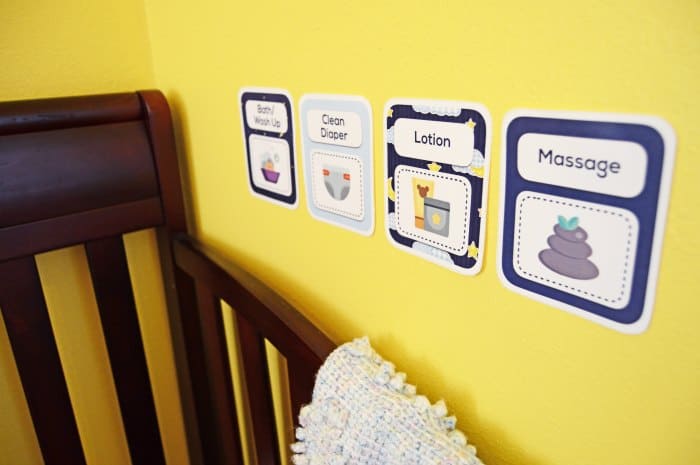
Don’t let naps get too long. Sleeping too long of a stretch during the day can rob nighttime sleep. Limit naps to approximately 2 hours during the day. If the baby sleeps past the two hour mark, it is absolutely okay to wake a sleeping baby. If you feel the baby truly needs longer naps, feel free to make adjustments and increase the nap limit to 2.5 hours.
Swaddle. From birth to about age four to five months, a baby possesses the startle reflex, in which the baby actually feels as if he is falling. The sensation of falling causes jerking movements, and the baby will inadvertently wake up. Keeping a tight swaddle prevents babies from startling awake, helping the baby sleep both better and longer.
Create a good sleep environment. Dimming the room by closing the blinds or curtains is great a great place to start. Using a small fan or white noise machine in the room is also helpful if your baby struggles to sleep through noise.
Encourage full feedings. When the baby eats a full meal, it will be easier to make it to the next feeding time. It is also easier for the baby to complete a full nap without waking early due to hunger.
Dreamfeed. Before going to bed, we can pick the baby up without really waking him and give an additional feeding. The dream feed helps prevent the baby from waking up shortly after we moms go to sleep.
3. Start laying the baby down awake…
When you lay the baby down awake, there will likely be some crying involved. Crying should be in no way extreme or long in duration. If your baby is struggling to fall asleep on his own, reassurance and support from mom or dad is really important. Allowing your baby to become very drowsy, yet slightly awake can really help with this process. If your baby is fussing for a long time, it can frequently be attributed to overtired or overstimulation but there are many other disruptions that may be the culprit.
It is common for Babywise parents to start somewhere in the birth to 2 month window. It isn’t necessary to choose before the baby is born; it’s okay to get to know the baby and start when you instinctively think it is best. We started at age 6 weeks.
Lay the baby down for a nap after meeting all of the baby’s needs (fed, changed, etc) and the baby has been awake for a bit and the baby is showing sleepy cues (i.e. a yawn, a fuss, or an eye rub). When my son was getting close to a nap, I would keep stimulation to a minimum. Sometimes I would just walk him around the house for a bit and hum softly.
Then I would take him to his room, close the curtains, place him in his sleep sack or swaddle, turn on the white noise, and hold him for a few minutes. Next, I would say his Sleepy Words…something like ‘I love you. I hope you have a good sleep. I’ll see you when you wake up.’
And finally, I would lay him down. On average, he would fuss from 0-10 minutes. Of course, some days he didn’t fuss at all and some days he fussed for longer. We stayed very, very consistent. And by 3 months there was no fussing before naps or bedtime at all, unless something was off such as travel or overtired or overstimulated.

You can also try ‘shush-pat’: I originally tried ‘Shush-pat’ method from the Baby Whisperer book. After preparing the baby for sleep, you can make a gentle shushing sound and pat your baby’s back while you are holding him. Then lay your baby down drowsy, but awake and continue shushing and pat his side or chest until he falls asleep. This is a great method to help your baby get used the crib.
4. Consistency is key.
This is so important. I stayed home for a few short weeks once I started to set the foundation and provide my son the opportunity to get the hang of it very quickly. This also prevents the baby from falling asleep in your arms or the car when you are out, allowing us to stay on schedule at least until the foundation is set. After the initial two week period, I got a little more adventurous with leaving the house. We can’t stay inside forever, right?!
Beginning to sleep-train using Babywise does involve some work, but the fruits of your labor will undoubtedly pay off. He started sleeping 10+ hours through the night at around four months, which at the time, was a much welcomed change. I hemmed and hawed for a little while about letting go of the night feedings. All babies will regress at some point (i.e. teething, growth spurts, and beyond), and you will be awake during the night feeding the baby once again. In the meantime, it’s okay to give yourself permission to get some much needed rest.
Want more on baby sleep?
- My Top 10 Newborn Baby Sleep Tips To Help You Get More Sleep
- The Newborn Routine That Will Help Your Baby Fall Asleep Faster
- Top 7 Challenges + Solutions for Parenting a Newborn and Toddler
- 8 Infant Sleep Facts Every Parent Should Know
Resources for baby sleep:










We are pregnant with our second and I’m excited to utilize this checklist! It took us a long time to figure out a routine with our first, but once established we felt we could breathe again. This time having number one to chase around it will help with my sanity to have some sort of schedule and I hope will help number one adjust better. Anyone have thoughts on how to help my eldest with this upcoming transition? Especially with keeping his sleep schedule normal and not interrupted by a crying newborn? He’ll be 22 months when little one arrives.
This article was sent to me by a friend, and lucky me she did! This book is a dream; a true gift sent to young parents who 1) need sleep and 2) want to teach our precious new babies how to sleep. I found the need to train around a routine most necessary and agree with the authors that using common sense around this strategy is the key. Thank you, Lauren!!!
Here’s what I think *every* parent needs to know about their baby– every baby is different, every parent is different, and everyone needs a whole heck of a lot of grace. Babywise gives such a wide net of tools and guidance that I truly believe the majority of parents could implement at least some of their methodology. My oldest was an absolute dream to sleep train, we only did it once at 6 weeks old and he was sleeping 12 hours by 12 weeks. Easy peasy. My youngest though… wow. Totally different story! He was ROUGH. But I know he would have been even more difficult to sleep train later on when he was ready if we hadn’t begun implementing babywise tools early on. For example, we kept the beginning and end of the day the same pretty much from day one. Gradually, as he became developmentally ready for it (every baby is different), we added more tools. We kept him to a fairly reliable feeding schedule even when his naps were all over the place. Over time, his consistent metabolism (set by the feeding schedule) helped his naps even out. I know some parents are overwhelmed by the sheer number of methods, tips, and tricks in Babywise, but you just have to start somewhere. It doesn’t have to be perfect, it just has to start. And over time everyone will be happier because everyone will be sleeping (hallelujah) and it will be because you just started somewhere, even if only with one thing. Thanks for taking the time to break down all those tips into this article, I referenced this many times as we battled our second-born in sleeping. <3
Oh my goodness! Laying baby down awake! This was so hard to do not because it was actually hard, but because it seemed easier to just let my babe fall asleep and stay asleep in my arms. But after making a habit of laying him down awake, we ALL slept better!!
These steps were KEY to all of us getting better sleep!!
Thanks for this post! What I’m unsure of is how exactly do you drop a night feeding? Will they naturally drop it or do I need to initiate it? My baby sleeps from 7pm to 12am. Then he’s up again at 2:30am and 5:30am. I would LOVE to drop the 2:30am feeding! I’m just not sure how. My baby is 12weeks and we have a great night bedtime routine and nap routine. He falls asleep on his own in his crib.
At one point in this blog (under the create a routine for the day section) you mentioned “wake, eat, sleep” rather than “eat, wake, sleep”. Was there a reason for that change or was it a typo? Thanks!
Lauren– i have found that self-soothing is the answer. I don’t know why any reader of Babywise would connect CIO with these great tools. Babywise is nothing like CIO. The author himself says right in Babywise to “Listen to your Babies cues.” I found it to be loving and helped us be flexible with the schedule. I love that Dr. Bucknam said, “your babies’ hunger cues always trump the clock.” We have found it very successful for our family.
Hi linda
i always thought Babywise told parents to cry it out. your quotes by dr. bucknam were very helpful. i guess that is why i shouldn’t take others words for it, should just read it for myself. i had several friends tell me i need to use babywise. i will read it now that i see your quotes by the author. sounds super flexible and empowering to moms:):)
Brianne- glad that was enlightening. it is so flexible and loving. best wishes with your little one.
Linda- my friend just sent me your quote from the author of Babywise and i had to tell you THANK YOU. I have been struggling with several methods of sleep help for my little guy. I had elected not to implement Babywise because i had a friend tell me it is completely CIO. And I just couldn’t do anything close to CIO. Knowing the Babywise author said “Listen to your Babies cues” and “your babies’ hunger cues always trump the clock” is a game changer for me. THANK YOU SO MUCH!
i am so glad, kelly.
ls