
 Schedule / Routine
Sometimes when we start something new, it’s difficult to know where exactly to begin and what exactly to expect. After reading On Becoming Babywise, my husband and I knew we wanted to sleep-train using Babywise, but translating written content into real life application involves a learning curve.

I really fumbled along for quite some time in the beginning trying to figure out all the baby sleep tips and newborn routines. I’ve said before that my son was a challenging sleeper in his early days, and my husband and I spent an awful lot of time troubleshooting. It was far from a perfect process, but I learned and grew as a mother during that time. There are a few basic ideas we can all keep in mind when preparing to start Babywise.
1. Mentally prepare before the baby is born.
As a basic first step, read On Becoming Babywise as a couple and then talk about it together. When both parents are on board, everything runs more smoothly. Here are a few things I try to remind myself, when sleep-training…
- Babies will likely start sleeping longer stretches around 3-4 months.
- Troubleshooting at various points throughout the process is normal!
- Stay committed! You will see results!
- It is always okay to make modifications!
- Set the foundation! It will have positive lasting effects in the future months and years to come!
2. Start the basics at birth.
Last week I talked about my top infant sleep tips, which are just a few easy basics we can start from birth. Today I’d like to expand on that and talk about a few additional basics to help anyone preparing to start Babywise.
If you need to get acclimated for a few weeks before starting the basics that is 100% okay. Don’t stress! I was a nervous, anxious wreck that I wasn’t doing everything right from the beginning. It was a total waste of energy. The one thing that helped ground me during the postpartum period was essential oils. I used Frankincense and Lavender daily to support emotional wellness and Ningxia Red to keep my energy up.

Set a morning wake up time and a bedtime. We want to set the baby’s internal clock to encourage consistent night time sleep. It’s most common to see a 7 am wake time and a 7 pm bedtime. In a newborn, you may have a slightly later bedtime for a short while to help fit in enough feedings. After a few months, bedtime can usually be moved to an earlier time.
Create a basic routine for your day. Using the wake, eat, sleep cycle, fill in your approximate times for feedings and naps. In the beginning we are all likely on an approximate 2.5 hour to 3 hour schedule. If you set a wake time and a bedtime, it’s easy to fill in the middle.
Start a pre-sleep ritual. A 5 minute pre-nap routine and a 30 minute before-bedtime routine is simple, practical and easy to use. A pre-nap ritual could include swaddling the baby, sitting for a bit, singing a short song, and saying your sleepy words (e.g. I love you. I hope you have a good sleep, and I will see you when you wake up). A before-bedtime routine could include a bath, soft music, reading a short story, nursing the baby, and saying your sleepy words. Do what works for you.
You can use these newborn routine and baby routine cards to help create a consistent routine…
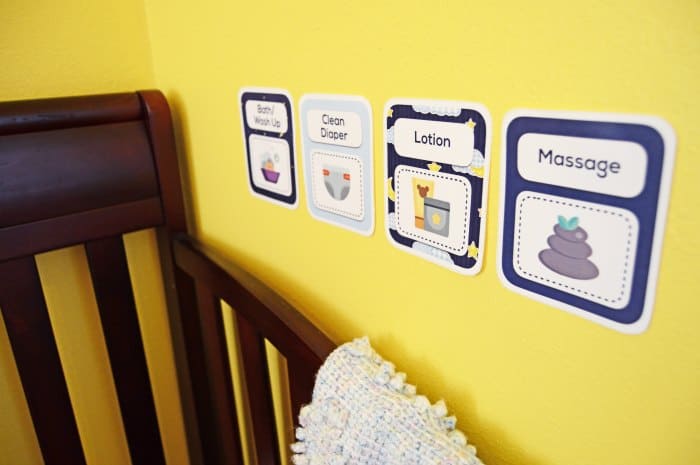
Don’t let naps get too long. Sleeping too long of a stretch during the day can rob nighttime sleep. Limit naps to approximately 2 hours during the day. If the baby sleeps past the two hour mark, it is absolutely okay to wake a sleeping baby. If you feel the baby truly needs longer naps, feel free to make adjustments and increase the nap limit to 2.5 hours.
Swaddle. From birth to about age four to five months, a baby possesses the startle reflex, in which the baby actually feels as if he is falling. The sensation of falling causes jerking movements, and the baby will inadvertently wake up. Keeping a tight swaddle prevents babies from startling awake, helping the baby sleep both better and longer.
Create a good sleep environment. Dimming the room by closing the blinds or curtains is great a great place to start. Using a small fan or white noise machine in the room is also helpful if your baby struggles to sleep through noise.
Encourage full feedings. When the baby eats a full meal, it will be easier to make it to the next feeding time. It is also easier for the baby to complete a full nap without waking early due to hunger.
Dreamfeed. Before going to bed, we can pick the baby up without really waking him and give an additional feeding. The dream feed helps prevent the baby from waking up shortly after we moms go to sleep.
3. Start laying the baby down awake…
When you lay the baby down awake, there will likely be some crying involved. Crying should be in no way extreme or long in duration. If your baby is struggling to fall asleep on his own, reassurance and support from mom or dad is really important. Allowing your baby to become very drowsy, yet slightly awake can really help with this process. If your baby is fussing for a long time, it can frequently be attributed to overtired or overstimulation but there are many other disruptions that may be the culprit.
It is common for Babywise parents to start somewhere in the birth to 2 month window. It isn’t necessary to choose before the baby is born; it’s okay to get to know the baby and start when you instinctively think it is best. We started at age 6 weeks.
Lay the baby down for a nap after meeting all of the baby’s needs (fed, changed, etc) and the baby has been awake for a bit and the baby is showing sleepy cues (i.e. a yawn, a fuss, or an eye rub). When my son was getting close to a nap, I would keep stimulation to a minimum. Sometimes I would just walk him around the house for a bit and hum softly.
Then I would take him to his room, close the curtains, place him in his sleep sack or swaddle, turn on the white noise, and hold him for a few minutes. Next, I would say his Sleepy Words…something like ‘I love you. I hope you have a good sleep. I’ll see you when you wake up.’
And finally, I would lay him down. On average, he would fuss from 0-10 minutes. Of course, some days he didn’t fuss at all and some days he fussed for longer. We stayed very, very consistent. And by 3 months there was no fussing before naps or bedtime at all, unless something was off such as travel or overtired or overstimulated.

You can also try ‘shush-pat’: I originally tried ‘Shush-pat’ method from the Baby Whisperer book. After preparing the baby for sleep, you can make a gentle shushing sound and pat your baby’s back while you are holding him. Then lay your baby down drowsy, but awake and continue shushing and pat his side or chest until he falls asleep. This is a great method to help your baby get used the crib.
4. Consistency is key.
This is so important. I stayed home for a few short weeks once I started to set the foundation and provide my son the opportunity to get the hang of it very quickly. This also prevents the baby from falling asleep in your arms or the car when you are out, allowing us to stay on schedule at least until the foundation is set. After the initial two week period, I got a little more adventurous with leaving the house. We can’t stay inside forever, right?!
Beginning to sleep-train using Babywise does involve some work, but the fruits of your labor will undoubtedly pay off. He started sleeping 10+ hours through the night at around four months, which at the time, was a much welcomed change. I hemmed and hawed for a little while about letting go of the night feedings. All babies will regress at some point (i.e. teething, growth spurts, and beyond), and you will be awake during the night feeding the baby once again. In the meantime, it’s okay to give yourself permission to get some much needed rest.
Want more on baby sleep?
- My Top 10 Newborn Baby Sleep Tips To Help You Get More Sleep
- The Newborn Routine That Will Help Your Baby Fall Asleep Faster
- Top 7 Challenges + Solutions for Parenting a Newborn and Toddler
- 8 Infant Sleep Facts Every Parent Should Know
Resources for baby sleep:










I appreciate how detailed this article is, without giving too much information that it becomes overwhelming. We have three children, and Babywise worked wonders for us in the transition of welcoming each one of them into our lives. Having a clear guideline (with room for accommodating each child’s individual needs) made sleep-training doable, while keeping my sanity in tact. I know many moms (including myself with one of my babes) whose baby would wake up seemingly for the day between 4:30-5:00 AM. Any suggestions on getting that wake-up time to be a little later?
These are some great tips! Consistency is definitely important, but with fluctuating work schedules, it seems nearly impossible to do. How can you set up a good routine for your baby when it seems like your own days don’t look the same day-to-day?
That has always been my question as well. Our days fluctuate so much–based on every family member’s needs. Being able to plug away with the first pass at a routine is so hard. I found that simply “starting” some sort of routine was the key. It is so great once the routine sticks!
Thank you! Probably committing to something and actually STARTING it is the biggest part. I need to look for some ways to at least introduce consistency in the day-to-day. Just not sure what that looks like.
This seems like it has all the information you would need to sleep train. I think the Babywise book is pretty lengthy. Does it just go more into detail about the steps you mentioned or are there even more practical steps to help become successful in sleep training?
This all sounds great, but what if you didn’t sleep training early and your baby has developed habits like always needing to be rocked to sleep or wanting to sleep in your arms? How do you break these habits without going insane?
Is it better to make the baby’s room dark, or to try to keep the room lighter during the day as to not confuse him about when it is day/night? What about noise? I don’t like the idea of trying to keep everything and everyone quieter than normal during the day, but I definitely want to encourage better, longer naps.
In my experience, making the room totally dark made it harder to get my baby to nap in other people’s, who didn’t have black-out curtains or a totally dark space, homes. He really got to the point where he would only ever nap in his room which made it hard when we were on vacation or visiting friends. I think just a nice relaxing environment with regular curtains, not black out curtains, and a white noise machine to drown out the other noises of the day is perfect.
What would be a reasonable age to drop the dream feed? I sometimes think it disturbs the baby more than helps.
I believe Babywise babies can typically drop the dream feed anywhere from 4-7 months. I would consider dropping it once your baby is consistently sleeping from dream feed until that first feeding of the morning. As you mentioned though, I also felt that it was more disruptive than anything else for one of my babies. I just tested out dropping it for a couple nights and he started sleeping through the night immediately. If this is the approach you decide to take, just make sure your little one is getting the recommended number of feedings during the day so that he/she is still getting all of the nutrition he needs. Good luck!
Love the summary! Consistency is huge! My wife and I went through baby wise and it really helped us get on the same page with understanding our baby’s needs and being on the same page.
How do you maintain a social life and have a consistent sleep schedule? That’s something we’ve struggled with.
We just got into hosting more and more! It’s easy to have people over to your home when you can put the kids to bed easily and at a consistent time!
How do you encourage full feedings when baby refuses to eat or us to sleepy to eat?
Also my 4 month old was sleeping through the night from 6 weeks old till just a couple weeks ago. Like solid 10-12 hours through the night! ? Then he got sick and started waking up so I fed him cause I wanted him to get all the breasmilk he could to fight off sickness. Now he’s better but he wakes up knowing I’ll feed him now. It’s only 2 times he eats a goes right back to sleep.
Should I let him cry out the first time he wakes up then just feed him if he wakes for early am feeding?
How to you reassure the baby that you are there and you care about him, but still train him to fall asleep on his own if he is crying for longer than 10-15 minutes? I hate to let him cry that long, but want him to develop good sleep habits and not need me to fall asleep.