
 Schedule / Routine
Sitting on the couch with my swollen legs propped up on pillows, I looked over at the stack of newborn baby sleep books on the coffee table. Over the course of several hours, I devoured each book, skimming through the pages.
I was determined to learn how to make a newborn sleep.
Then…my son was born.
And….he didn’t sleep.
Imagine that. A baby not sleeping the way a book says 🙂

I fumbled through it the first six weeks. I was so unsure of myself.
Thankfully, we pulled ourselves together, armed ourselves with some key infant sleep facts, developed a plan and implemented it.
We stuck with it, and at 4 months old, our son was sleeping 11-12 hours at night and naps extended to 1.5 to 2 hours. Woohoo! We’ve experienced sleep regression, sleeping on the go, sleeping through teething…and so much more!
post contains affiliate links for your convenience.
How to get a newborn to sleep.
Getting your newborn to sleep longer stretches at night is not a perfect process. There is an ebb and flow. It’s all about trying new things and finding something that works well for your baby.
We used these tips for our daughter, and she slept so well during the newborn phase, my husband and I enjoyed a generous amount of time hanging out.
Here’s the best part: When your baby sleeps better, you will notice a more patient, more tolerant, more engaging baby after a good night’s rest or quality nap.
1. Swaddle
From birth to about age four to five months, babies innately possess a startle reflex, in which they feel as if they are falling. The sensation of falling causes jerking movements, and the baby will incidentally wake up.
Keeping a tight swaddle prevents babies from startling themselves awake, helping the newborn baby sleep both better and longer. I like to think of the baby as ‘snug as a bug in a rug,’ and I used to tell my son this every time I’d swaddle him snugly.
I love the HALO SleepSack Cotton Swaddle
Both help keep the baby swaddled snugly yet safely.
Even if your baby seems to dislike the swaddle I would keep trying. If you think about how it was for them in the womb, it is a very familiar feeling for a baby to enjoy a snugness around them.
We stopped swaddling once our son could regularly get his arms out and roll over. We continued to use the Halo Sleep Swaddle and just swaddled around his torso, leaving his arms out.
2. Dreamfeed.
The dreamfeed is the feeding given to the baby right before you (mom or dad) go to bed, and it helps prevent the baby from waking up just after you finally drift off to sleep.
Isn’t this the pinnacle of sleep deprivation?
You just fall asleep and the baby wakes up.
The dreamfeed can help your newborn baby sleep for longer while you sleep. We used it until about age 4 months. After than time, it can start to disrupt sleep and create more nighttime waking.
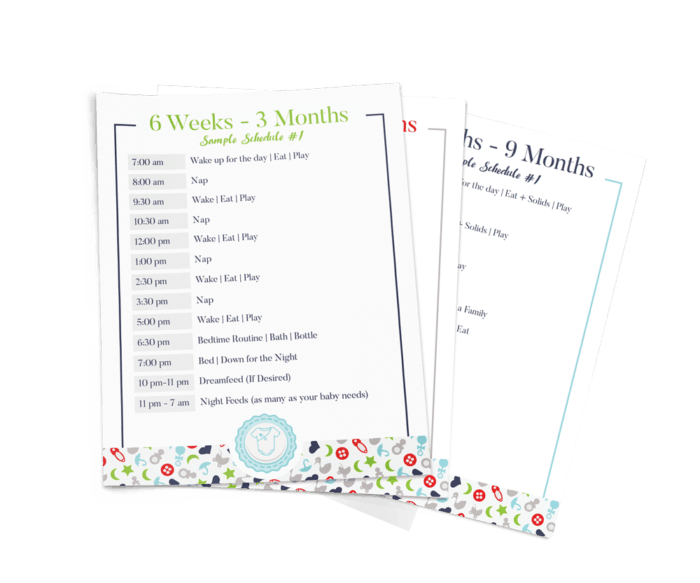
Here’s an example of a newborn sleep schedule that we loosely used during the first 3-12 weeks.
- 7 am – Wake up, eat, play
- 8 am – Nap
- 9:30 am – Wake up, eat, play
- 10:30 am – Nap
- 12:00 – Wake up, eat, play
- 1:00 pm – Nap
- 2:30 pm – Wake up, eat, play
- 3:30 pm – Nap
- 4:30 pm – Wake up, eat, play
- 5:30 – Cat nap
- 6:00 pm – Wake up, eat, play
- 7:30 – Eat again (cluster feed), then down for the night.
- 9:30 pm – Dreamfeed.
- 9:30 pm – 7 am – night feeds as needed.
Generally if you can get a newborn to go 3-4 hour stretches during the night from birth to 6 weeks that is pretty good! From 6-12 weeks if you can get a 4-6 hour stretch that’s great. Some babies will go 8-9 hour stretches with the dream feed.
When most author’s taut “getting baby to sleep through the night” they are referring to a 6 hour stretch of sleep. A newborn’s stomach is very small and I typically like to feed at least 2.5 hours during the day, cluster feed in the evenings AND dreamfeed. The more calories you’re able to feed during the day, the less they may need at night.
If you’re looking for more baby sleep schedules, check out my book Routines, Rhythms and Schedules. Inside there are 20+ printable schedules from birth to age 5.
3. Limit the length of naps during the day.
I know it’s hard to wake a sleeping baby, but sleeping too long of a stretch during the day can rob nighttime sleep. If the baby sleeps past the 2 – 2.5 hour mark, I would go ahead and wake the baby up, feed him, keep him a wake for a bit, and then lay him down for another nap. If you feel the baby truly needs longer naps, feel free to increase the nap limit to 2.5 hours. Breaking up sleep during the day will help your newborn baby sleep better at night. It also enables you to get more feedings in during the day, which is very helpful.
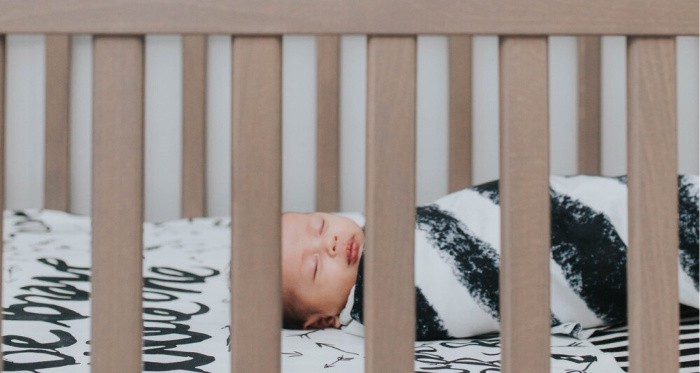
There were, of course, times where our son was overtired and needed a little recovery nap. We would allow him to sleep for a little bit longer for just that one nap and then we started getting back on track with our daily routine.
Related: How to Help Baby Take Longer Naps
4. Use white noise.
No one wants to miss a party, so if your baby is listening to all the fun going on in the house it can be hard to fall asleep and stay asleep.
I place a fan on medium in the baby’s room rather than directly next to the baby, so it does not blow directly on him or sit too close to his sensitive ears. Using white noise also helps immensely when we are traveling! We are usually able to avoid asking friends or family to be quiet 🙂
I’ve used both a regular fan and a white noise machine in the past.
5. Follow the eat, wake, sleep cycle.
The baby wakes from sleep and immediately eats. Then the baby is awake for a while to play. Then the baby goes back to sleep….
This cycle has several purposes. First, it encourages full feedings by allowing the baby to eat immediately after waking. The baby will have the most energy immediately after waking, making him more inclined to take a full feeding and go longer between feedings.
Also, by feeding the baby after sleep rather than before sleep, the cycle prevents the baby from associating food with sleep or using food as a sleep prop. When using this cycle, a feeding before bedtime is typically only feeding before sleep.
Of course, there were times where I definitely fed my baby before sleep. He needed a little TLC for a certain nap, and I was totally fine offering it when he needed it. But for the most part, I tried to avoid feeding him right before sleep.
Note: Newborns require frequent feedings and rest to ensure healthy growth a development in the early months. Always feed your baby as frequently as your baby needs to ensure healthy weight gain.
6. Use a pre-nap and bedtime routines.
It is well known that babies thrive on routine, structure, and predictability. Routines are also an excellent tool to help newborns get settle before sleep at night. Creating consistent routines will help bring order to a very chaotic world for your infant.
Choose a pre-nap routine that works for you.
A pre-nap routine may include taking the baby to his room, close the blinds or curtains, place the baby in his sleep sack or wearable blanket, turn on the white noise, sing a quick song (e.g. Twinkle, twinkle), give a few cuddles, and say your sleepy words “I love you. I hope you have a good sleep.”
A bedtime routine would typically be a little longer.
It may include a bath, a massage, reading a story, offering a feeding, placing the baby in a wearable blanket or swaddle, turning on the white noise, a few cuddles, and saying your sleepy words. Following the same exact routine as consistently as possible cues the baby for sleep, and over time the baby will learn that sleep immediately follows the nap and bedtime routines.
Use these printable (and adorable!) baby sleep routine cards to keep parents, grandparents and babysitters ALL on the same page.
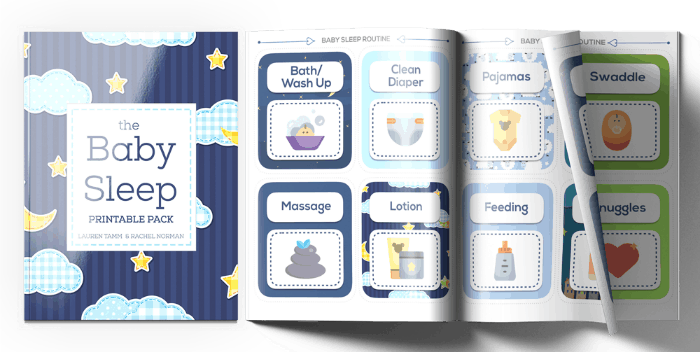
Inside the baby sleep printable pack, I also include a chart to help you know how much a newborn should sleep. It’s a great resource to use when creating your own custom newborn sleep schedule.

7. Change your baby’s diaper strategically…
Changing the diaper before a middle of the night feeding prevents the baby from waking up too much after a feeding is finished. When the baby wakes up change the diaper and re-swaddle to prepare him for sleep immediately following a night feeding. If you change the diaper after the night feeding, the baby may become too awake, making it more challenging for him to fall asleep.
Now, I’ve also heard from parents of very young newborn babies (Think: Birth to 3 weeks) sharing that the baby poops right after a night feeding. This is very common during the early newborn phase when babies are still working out the flow of their digestive tracts.
If your baby is consistently stooling after a night feeding, then certainly, just wait to change the diaper until after the feed. Once your baby’s gut matures and he or she stops stooling immediately after a night feed, you can go back to changing the diaper before the feed.
8. Understand how a baby sleeps.
The more your baby sleeps, the more they will sleep.
It’s backwards but true!
If your newborn won’t sleep, there’s a very good chance, he’s way overtired.
Keeping a baby awake in hopes of tiring him out will actually result in over-stimulation, and he will experience both difficulty falling asleep and staying asleep. It is very likely an overtired baby will sleep shorter, not longer.
Note: Sometimes this tip confuses readers. And it’s no wonder. First I said limit naps during the day, and now I said an overtired baby will sleep shorter, not longer.
Let me be more clear:
- Limiting the length of naps is important to support night time sleep. You want the baby to get in as many feedings as possible during the daytime. Think: More daytime feeds = less nighttime feeds.
- You don’t want to keep the baby awake for long stretches. Your baby will get over-tired, fussy and have difficulty falling back asleep.
- Bottom line: Encourage lots of naps AND feedings during the day following the eat, wake, sleep cycle.
Related: 8 Infant Sleep Facts Every Parent Should Know
9. Don’t rush in…
We may inadvertently encourage the start of a bad sleep habit by rushing in when a baby cries or rustles during the night. Often times, babies wake up babble and go back to sleep.
The baby may even cry briefly or babble and still be asleep.
Give the baby some time and see if he will resettle himself. Avoid rushing in and disturbing this process in order to help your newborn baby sleep better.

Waiting anywhere from 2-10 minutes to see if your newborn settles is a good place to start. There’s no exact science. Listen to your baby’s cries. If your baby is starting to escalate, it’s usually a good sign he needs some extra comfort and support.
10. Lay the baby down awake, but drowsy.
The most important way to encourage your newborn to sleep in the long run is to teach him to fall asleep independently, which is essentially the beginnings of teaching independent sleep.
Babies, like adults, will naturally wake up during the night. Without knowing how to get back to sleep, a baby will cry out after waking regardless of actual need, resulting in night waking droning on for much longer than is actually necessary.
Once a baby gets older, falling asleep independently enables a baby to drift back to sleep after waking in the night, ultimately helping your baby sleep better in the long run.
You can start by settling your baby into a drowsy state with your newborn baby routine, then lay your baby down in their safe sleep space. If needed, place a gentle but firm hand over your babies chest while he drifts off.









We have 9 week old twins and are really struggling. They like being swaddled but they also move around and break free. If we swaddle their arms by their faces they come loose within minutes. We do a white noise machine. We follow the wake eat sleep routine. We do dream feeds. We avoid changing diapers when they wake up at night. We are on the 2.5 hour schedule. Nothing seems to be working at all and it actually seems to be getting worse. They won’t nap more than 15 min at a one during the day. They do sleep overnight but wake up almost hourly. What else can we do or try?!? We are so sleep deprived and will try anything.
I’m confused on some contradicting tips. You said to dream feed but also not to let them rely on eating to fall asleep. Also you had stated that the baby should not sleep too much through the day, and then went on to say not allowing the baby to sleep enough could potentially have the baby over tired and not sleep long enough. At what age would you say I should switch strategies or how should I go about this?
-1st time mom
I was confused about the same points. Our little man is 9 days old.
When in doubt, swaddle it out!
The baby is sleeping during the day for a reason. It is dangerous and a foolish tip to tell people to keep their baby awake. Babies need sleep, they rely on rem sleep for brain connections and memories, too little rem sleep has been linked to autism. Rem sleep usually occurs in the later stage of a sleep. Please retract this from your article.
Really great article! I had very similar help from Susan Urban’s guide titled ‘How to teach a baby to fall asleep alone’. The two parts of the book are for parents with children aged from 0 to 3 months and from 3 months onwards. It says exactly what to do with babies to make them sleep better since they were born.
The author also describes what and how to use (like swaddling, rocking white noise etc) and when and how to stop using them.
I tried it with my boy so I can really recommend it.
Urban’s guide is amazing! Finally some clear and fast instructions that make sense. We succeed after only 3 days. Much faster than we expected. I so wish I had looked into these guides before I had my first baby! Thanks so much for posting the info about the guide
This is the most practical, honest guide about how to make your baby sleep. Thanks for sharing the info about this guide, I appreciate it.
I got this guide from my friends and at the beginning put it aside because I thought I wouldnt have such a problem, but soon lost my dream. However, after reading the guide, just after 2 days, my beloved daughter slept like an angel all night long. In addition, it turned out that I have problems with feeding, which is why I also bought “How to make a breastfeeding pleasant and easy” and the rest of the guides 😀 They are very cheap and useful. All tips in one place. All can be bought on her site https://www.parental-love.com/, but they are also available on the Amazon. Girls dont lose energy, if the solutions are so easily available, it isnt worth it. Regards!
I was just going to say those tips looks like from How to teach a baby how to sleep alone guide! I used the HWL method and it worked great. But I think it really helped a lot that we have had bedtime routine already established!
I’ve just purchased an audiobook! So many positive comments about it I’ve decided to give it a shot. Although I was never pro-sleep training if this HWL method works so amazing it seems to be worth a shot!
It’s totally worth it! I’ve never had more useful obok than Susan Ubran’s – short but giving you a lot of information at once! Brilliant.
This guide is brilliant! I’m surprised that I haven’t heard of it before!
The post is so useful, I will follow the instructions to have a good result. Thanks for sharing!
Hi Lauren,
Excellent tips. Swaddling makes a big difference as it comforts the baby just like he is in the womb.
What I have found to be effective in making my babies sleep in the night is dim the lights, make less noise . This makes my baby sleep atleast 3 hours a night and I can sleep too.
New mom question: I’m finding that after about 2 hrs of sleep my newborn seems to transition between active and quiet sleep as quickly as every 5 minutes, when he does finally wake up it is usually with a lot of crying. In this scenario would it be better to get him up when he first starts to rouse? Thanks for the advice and great article!
HI Lauren, I have gone through your article, and I have learnt quite awesome techniques from swaddle ,white noise and many more and thanks for mentioning such cool tools which you use. thanks a lot once again.
Hey buddy, being grateful as you posted such a useful and informative post. I like swaddling the most. 😀 I would like to save it. Thanks a lot for sharing your great thoughts. Keep posting, looking forward for more from you
Thanks so much responding and so quickly, Lauren! I really appreciate it! All very helpful information. Thank you!